



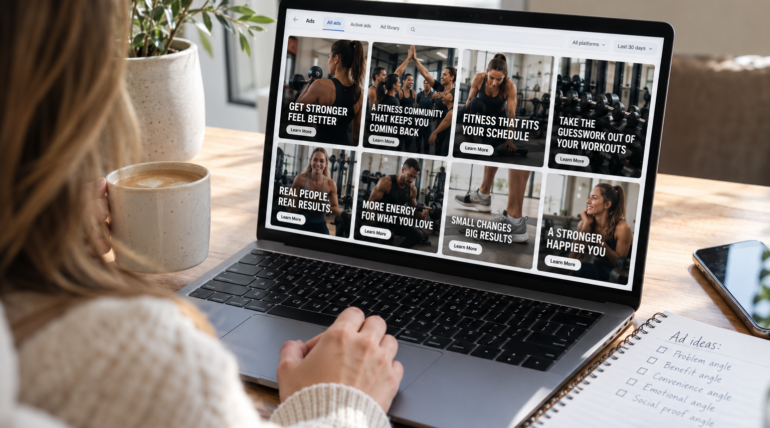
Why Social Media Ads Need More Than One Angle
A successful social media ad creative strategy involves more than finding one advertisement that performs well and repeatedly recreating it. Different customers can want the exact same product or service for completely different reasons, and understanding those motivations can help businesses create more effective advertising.
When a social media advertisement starts generating leads or sales, it’s natural to want to repeat that success.
You might change the photograph, update the background colour or create a new video while keeping the original headline and message.
Although these changes can be useful, they don’t necessarily tell you anything new about your audience.
The same message may continue reaching people who respond to one particular benefit while overlooking other potential customers with different priorities.
For example, two people might join the same gym. One wants to improve their fitness, while the other wants a convenient way to relieve stress after work.
They’re purchasing the same service, but their motivations are different.
A successful advertising strategy recognizes these differences and tests messages that speak to them.
What Is a Creative Angle in Social Media Advertising?
A creative angle is the specific perspective or message used to communicate why someone should be interested in a product or service.
It determines which problem, benefit, emotion or customer motivation an advertisement emphasizes.
For example, a residential cleaning company could advertise the same service using several different angles.
Time-saving angle: Spend less time cleaning and more time enjoying your weekends.
Convenience angle: Keep your home consistently clean without managing every household chore.
Family angle: Make maintaining a busy household easier.
Lifestyle angle: Come home to a clean, comfortable space.
Each advertisement promotes the same service, but the messaging speaks to a different reason someone might consider hiring a cleaning company.
This is what makes creative angles valuable.
Instead of assuming every potential customer responds to the same message, businesses can explore which motivations generate the strongest response.
Why Isn’t One Successful Social Media Ad Enough?
One successful advertisement can provide useful information about what resonates with your audience.
However, it doesn’t necessarily mean you’ve discovered the only message that works.
An advertisement may perform well because it appeals to a particular group of customers, highlights a timely concern or communicates a benefit that competitors aren’t emphasizing.
Other potential customers may have different priorities.
Consider a physiotherapy clinic promoting appointments.
One advertisement might focus on returning to exercise after an injury.
That message may resonate with active adults who want to get back to their routines.
But someone experiencing discomfort from sitting at a desk all day may not identify with the same advertisement.
A different message focusing on everyday movement and comfort could appeal to that audience.
Both groups may benefit from the clinic’s services, but they need different reasons to pay attention.
Testing multiple creative angles allows businesses to explore these opportunities without abandoning the messaging that already performs well.
What’s the Difference Between Changing an Ad’s Design and Changing Its Angle?
Changing an advertisement’s design affects how the message is presented.
Changing its angle affects what the message communicates.
For example, imagine a fitness studio running an advertisement with the headline:
“Get Stronger With Our Fitness Classes.”
The business could create several design variations:
A photograph of someone lifting weights
A video showing a group workout
A graphic featuring the studio’s branding
A different background colour
A new layout with the same headline
These changes may influence performance, but the central message remains the same.
Now consider testing different advertising angles:
Confidence: Feel stronger and more confident in your everyday life.
Convenience: Fit a great workout into your busy schedule.
Community: Find a supportive fitness community that keeps you motivated.
Structure: Take the guesswork out of your workouts.
These messages explore different reasons someone might join.
Both visual testing and messaging testing have value. However, businesses shouldn’t assume that changing an image is the same as testing a new advertising concept.
Why Do Different Customers Respond to Different Messages?
Customers make purchasing decisions based on a combination of practical needs, personal priorities and emotional motivations.
Even when people are searching for the same service, their reasons for choosing a business may differ.
Consider a homeowner looking for a painting contractor.
One homeowner may want to modernize an outdated living room.
Another may be preparing to sell their property.
A third may be renovating after purchasing their first home.
All three customers need painting services, but their motivations aren’t identical.
An advertisement focusing on modernizing a space may appeal to the first customer.
Messaging about preparing a home for sale may resonate with the second.
An advertisement emphasizing making a new house feel like home may appeal to the third.
Understanding these motivations allows businesses to create messages that feel more relevant to different customers.
What Types of Social Media Ad Angles Should Businesses Test?
There are several ways to approach creative testing, depending on the product, service and target audience.
1. Problem-Focused Advertising
Problem-focused advertisements highlight a challenge the customer is experiencing.
For example, a bookkeeping company might use:
“Spending Too Much Time Managing Your Books?”
This angle speaks to business owners who find financial administration time-consuming.
Problem-focused messaging can work well when customers already recognize a challenge but haven’t decided how to address it.
The key is to describe the problem accurately without exaggerating or creating unnecessary fear.
2. Benefit-Focused Advertising
Benefit-focused advertisements emphasize what the customer gains from using a product or service.
For example, a landscaping company might use:
“Enjoy a Beautiful Yard Without the Weekend Work.”
Rather than focusing on the difficulty of yard maintenance, the advertisement highlights the desired outcome.
This can be effective when customers understand the service but need a compelling reason to invest in it.
3. Convenience-Focused Advertising
Convenience is a strong motivation for customers who value time, simplicity and accessibility.
For example, a meal preparation company might highlight:
“Fresh, Ready-to-Eat Meals for Busy Weekdays.”
This angle appeals to people looking for a practical solution that fits their routines.
Convenience messaging should be specific about what makes the experience easier rather than relying on vague promises.
4. Emotion-Focused Advertising
Emotional angles connect a product or service with feelings or experiences customers value.
For example, a home renovation company might emphasize the excitement of creating a space where family and friends can gather.
A fitness studio might highlight the confidence that comes from developing a consistent exercise routine.
Emotional messaging should remain authentic and avoid making unrealistic promises about personal outcomes.
5. Value-Focused Advertising
Value-focused advertisements communicate what customers receive in exchange for their investment.
This doesn’t necessarily mean emphasizing discounts.
A premium service might highlight expertise, quality, customization or long-term benefits.
For example, a custom furniture company could emphasize craftsmanship and materials rather than competing primarily on price.
The goal is to help customers understand why the offering is worth considering.
6. Trust-Focused Advertising
Some customers are less concerned about discovering a new service and more concerned about choosing a reliable provider.
Trust-focused messaging can highlight verifiable credentials, experience, customer testimonials or a transparent process.
For example, a renovation company might feature completed projects and explain how estimates and timelines are handled.
This angle can be particularly useful for services that involve significant financial commitments.
How Do You Find the Right Advertising Angles for Your Audience?
The best creative angles usually come from understanding your customers rather than guessing what might attract attention.
Before creating new advertisements, businesses should consider why people purchase their products or services.
Customer reviews, sales conversations, frequently asked questions and feedback from existing clients can all reveal useful information.
For example, a cleaning company may initially assume customers hire them because they dislike cleaning.
However, conversations with customers might reveal several different motivations.
Some customers may work long hours and want more free time. Others may need help maintaining larger homes. Some may simply prefer having a consistent cleaning routine.
These insights can become the foundation for different advertising messages.
A useful starting point is to ask:
What problems are customers trying to solve?
What benefits do they mention most often?
What concerns prevent them from purchasing?
Why do customers choose our business over competitors?
What changes in their lives make them start looking for our service?
The answers can help businesses develop advertising angles based on genuine customer needs.
How Many Social Media Ad Angles Should You Test?
There isn’t one ideal number of creative angles for every campaign.
The appropriate approach depends on advertising budget, audience size, campaign objectives and the amount of data available.
For businesses with smaller budgets, testing two or three distinct angles may be more practical than launching ten advertisements simultaneously.
For example, a local gym might begin with:
Ad 1: Convenience
“Get a Full-Body Workout That Fits Your Schedule.”
Ad 2: Community
“Find a Fitness Community That Keeps You Coming Back.”
Ad 3: Structure
“Take the Guesswork Out of Your Fitness Routine.”
Each advertisement promotes the same business while exploring a different customer motivation.
By comparing results over time, the business can begin identifying which messages generate meaningful engagement and qualified inquiries.
However, testing too many advertisements with a limited budget can spread spending too thinly, making it difficult to gather useful information.
A focused testing strategy is often more manageable.
Should You Turn Off a Successful Ad to Test Something New?
Not necessarily.
One of the biggest mistakes businesses can make is replacing a successful advertisement simply because they want to introduce something different.
If an advertisement consistently generates qualified leads or sales at an acceptable cost, there may be little reason to stop running it immediately.
Instead, businesses can introduce new creative angles alongside their existing advertisements, provided their budgets and campaign structures support meaningful testing.
This approach allows businesses to explore new opportunities without unnecessarily abandoning proven messaging.
For example, a fitness studio may have an advertisement focused on affordability that has performed consistently for several months.
Rather than replacing it with a completely different message, the business could test a convenience-focused advertisement while monitoring the original.
The results may reveal that both angles attract valuable customers.
Alternatively, the new advertisement may outperform the original and provide an opportunity to adjust the campaign.
The objective is to learn from new messaging while protecting what already works.
How Can You Test Different Ad Angles Without Confusing the Results?
Creative testing works best when businesses understand what they’re trying to learn.
If you change the headline, image, audience, landing page and offer simultaneously, it becomes difficult to determine which change influenced performance.
For example, imagine a cleaning company wants to test whether customers respond more strongly to time-saving messaging or convenience messaging.
The business could create two advertisements with similar visual styles, formats and offers while changing the central message.
Version A: “Get Your Weekends Back With Professional House Cleaning.”
Version B: “Enjoy a Consistently Clean Home Without the Extra Work.”
This comparison focuses primarily on the advertising angle.
Alternatively, if the business wants to test imagery, it could keep the messaging consistent while changing the photograph or video.
Meta provides advertising tools and resources that businesses can use when developing and managing campaigns across Facebook and Instagram.
When available and appropriate, controlled A/B testing can help compare variations more reliably than simply observing two advertisements running under different conditions.
Which Metrics Should You Use to Evaluate Social Media Ad Angles?
The most engaging advertisement isn’t always the one that generates the best business results.
A creative angle may attract attention, comments or clicks without producing qualified leads.
Businesses should evaluate creative performance based on the objectives of their campaigns.
Click-Through Rate
Click-through rate measures how frequently people click an advertisement after seeing it.
A strong CTR can indicate that the message is attracting interest.
However, clicks alone don’t determine whether an advertisement is successful.
Cost Per Lead
Cost per lead measures how much advertising spend is required to generate an inquiry.
This is particularly useful for service-based businesses running lead generation campaigns.
However, a low cost per lead doesn’t automatically mean those inquiries are valuable.
Lead Quality
Lead quality evaluates whether inquiries come from people who are suitable potential customers.
For example, one advertisement might generate many inquiries from people outside a company’s service area.
Another might generate fewer inquiries but attract customers who are ready to book.
The second advertisement may provide greater business value.
Conversion Rate
Conversion rate measures how frequently people complete a desired action, such as submitting a form, booking an appointment or making a purchase.
Comparing conversion rates can help identify which messages encourage people to take meaningful action.
Cost Per Acquisition
For businesses tracking completed sales or customer acquisitions, cost per acquisition can provide a clearer understanding of advertising profitability.
The goal is to identify which creative angles attract customers who are likely to take action, not simply which advertisements receive the most attention.
Can Different Ad Angles Improve Lead Quality?
Yes. Different advertising angles can help businesses attract people whose needs align more closely with their offerings.
Consider a premium landscaping company.
An advertisement focused on affordability may generate inquiries from customers searching for the lowest possible price.
However, the company may specialize in custom landscape design projects that require larger investments.
A creative angle emphasizing personalized design, craftsmanship and completed projects may attract customers who better understand the service.
The second advertisement might generate fewer inquiries, but those leads could be more relevant to the business.
This is why messaging should reflect not only what attracts attention but also what makes someone a suitable customer.
Clear advertising can help potential customers understand whether a service is right for them before they submit an inquiry.
Why Do Social Media Ads Sometimes Stop Performing?
An advertisement that previously generated strong results may become less effective over time.
There are several possible reasons.
The audience may have seen the advertisement repeatedly. Competitors may introduce new offers. Customer priorities may change. Seasonal demand can also influence performance.
However, declining results don’t automatically mean the advertisement has become ineffective because of creative fatigue.
Campaign performance can also be affected by changes in targeting, budgets, competition, conversion tracking and other factors.
Businesses should investigate these possibilities before assuming they need entirely new advertisements.
When creative fatigue appears to be contributing to declining performance, testing different messages can help introduce variety and explore new ways of reaching potential customers.
Rather than simply replacing one photograph with another, businesses can revisit the underlying motivation being communicated.
Should Facebook and Instagram Ads Use the Same Creative Angles?
The same creative angle can work across Facebook and Instagram, but the presentation may need to change.
For example, a fitness studio could use a community-focused message on both platforms.
On Facebook, the advertisement might feature a photograph of members training together with a caption explaining the supportive environment.
On Instagram, the same angle might be communicated through a short Reel showing members participating in a group workout.
The central message remains consistent, but the format reflects how people experience content on each platform.
Businesses should also consider placement requirements, video length, image dimensions and the way text appears on different devices.
The objective is to communicate the message clearly rather than assuming every advertisement needs to look identical across platforms.
How Can Different Creative Angles Support the Customer Journey?
Not every potential customer is ready to purchase immediately.
Some people are discovering a problem, while others are comparing options or deciding which business to contact.
Different creative angles can support these stages.
Awareness: Introduce a problem or benefit that helps people recognize why a service may be useful.
Consideration: Explain how the service works, what makes it different or how it addresses common concerns.
Decision: Highlight relevant proof, clear offers or practical next steps that help customers move forward.
For example, someone unfamiliar with professional cleaning services may respond to an advertisement about saving time.
Someone who has already considered hiring a cleaner may be more interested in how appointments work, what services are included and whether the company is reliable.
A business can use different creative angles to address these needs without relying on the same message for every customer.
How Does Creative Testing Fit Into a Larger Social Media Advertising Strategy?
Creative testing is one component of an effective social media advertising strategy.
Even strong messaging may struggle if the campaign targets an unsuitable audience, promotes an unclear offer or sends visitors to a confusing landing page.
Businesses should consider how their advertisements connect with the overall customer experience.
For example, an advertisement emphasizing convenient online booking should lead to a page where booking is straightforward.
An advertisement promoting a specialized service should direct visitors to information about that specific service rather than a generic homepage.
This consistency helps potential customers move from initial interest to meaningful action.
A well-planned social media marketing strategy should connect creative messaging with audience targeting, campaign objectives, landing pages and conversion tracking.
Testing different angles can provide valuable insights, but those insights become more useful when they inform the broader advertising strategy.
What Should You Do When You Find a Winning Ad Angle?
When a creative angle consistently generates strong results, businesses should look for opportunities to build on what they’ve learned.
However, this doesn’t mean recreating the same advertisement indefinitely.
Instead, consider why the message resonates with customers.
For example, if convenience-focused messaging performs well for a fitness studio, the business could explore related concepts such as:
Short workouts for busy schedules
Flexible class times
Convenient locations
Structured workouts that require less planning
These variations build on the same customer motivation while exploring different ways to communicate it.
At the same time, businesses should continue testing other motivations.
A successful convenience-focused advertisement doesn’t mean customers aren’t also interested in community, confidence or affordability.
The strongest long-term strategy often involves combining proven messages with thoughtful experimentation.
Better Social Media Ads Start With Better Messaging
Successful social media advertising isn’t just about producing attractive graphics or attention-grabbing videos.
It’s about understanding why customers might want your product or service and communicating those reasons effectively.
When businesses find an advertisement that performs well, it can be tempting to repeat the same message with slightly different visuals.
But different customers may be motivated by entirely different problems, benefits and priorities.
Testing multiple creative angles helps businesses understand their audience more deeply, discover new opportunities and make more informed advertising decisions.
For businesses investing in Facebook and Instagram advertising, the goal should be to develop a creative strategy that continues learning from customer behaviour rather than relying on one successful message.
Sometimes the biggest improvement doesn’t come from changing how an advertisement looks. It comes from changing what the advertisement says.
