



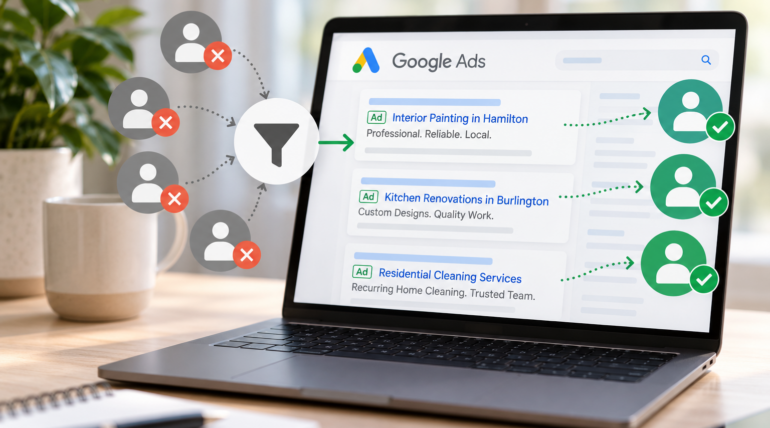
Improving Google Ads lead quality isn’t always about getting more people to click your advertisements. Sometimes, the most effective advertising strategy involves helping the wrong customers recognize that your business isn’t the right fit before they click.
It’s easy to assume that a successful Google Ads campaign should generate as many clicks as possible. After all, more clicks mean more visitors to your website, and more visitors should mean more opportunities to generate business.
But that isn’t always how it works.
A business can receive hundreds of clicks from people who are unlikely to become customers. Some may be searching for services the business doesn’t offer, looking outside its service area or expecting prices that don’t align with what the company provides.
Those clicks can consume advertising budgets without creating meaningful opportunities.
Clear Google Ads messaging helps potential customers understand what your business offers, who it serves and whether it’s relevant to their needs.
The goal isn’t to discourage people from visiting your website unnecessarily. It’s to attract people who are genuinely interested in what your business provides.
Why Are More Google Ads Clicks Not Always Better?
More clicks can increase website traffic, but traffic alone doesn’t tell you whether your advertising is successful.
Google Ads often operates on a pay-per-click model, meaning advertisers pay when someone clicks an advertisement. The amount paid varies based on factors such as competition, bidding strategy and auction conditions.
If someone clicks an ad expecting a service you don’t provide, that click may still cost money.
Consider a painting company that specializes in residential interior painting.
If its advertisement simply says “Professional Painting Services,” it might attract homeowners, commercial property managers, people looking for industrial painting or customers searching for specialty services the company doesn’t offer.
Some of those visitors may leave the website immediately after discovering the business isn’t relevant to their needs.
A more specific advertisement, such as “Interior House Painting for Homeowners,” gives searchers additional information before they click.
The narrower message may appeal to fewer people, but those who click are more likely to be interested in the service being advertised.
This is why click volume should be evaluated alongside lead quality, conversion rates and business outcomes.
What Is a Qualified Google Ads Lead?
A qualified Google Ads lead is someone who expresses interest in a business and meets important criteria that make them a realistic potential customer.
Those criteria vary depending on the company.
For a local service business, a qualified lead might be someone who lives within the service area and needs a service the company provides.
For a business offering specialized services, a qualified lead may need to meet specific project requirements or have a particular type of problem.
For a company selling premium products, a qualified lead might be someone whose expectations align with the product’s price and features.
A form submission or phone call doesn’t automatically mean someone is a qualified lead.
For example, a business could receive 30 inquiries in one month, but if 20 are from people outside its service area, those inquiries may create additional administrative work without generating sales opportunities.
A smaller number of well-matched inquiries can sometimes produce better business results.
How Does Google Ads Messaging Help Filter Out Poor-Fit Customers?
Google Ads messaging helps filter potential customers by communicating important information before they reach your website.
Search advertisements have limited space, so every headline and description should serve a purpose.
Rather than relying exclusively on broad promotional phrases such as “Quality Service” or “Contact Us Today,” businesses can use that space to clarify what makes their services relevant.
There are several ways to do this effectively.
1. Mention Your Service Area
Location matters for businesses that serve specific cities or regions.
A roofing contractor based in Hamilton, Ontario, may not want to receive inquiries from homeowners in Ottawa.
Including “Roofing Services in Hamilton” or “Serving Hamilton and Burlington” in an advertisement helps communicate where the business operates.
This doesn’t replace proper geographic targeting in Google Ads. Location settings still need to be configured carefully.
However, mentioning the service area provides another opportunity to clarify expectations.
It’s especially useful when searchers use broad phrases that don’t include a city.
2. Be Specific About the Services You Offer
Broad advertising language can attract broad expectations.
For example, a company specializing in residential cleaning may not offer commercial office cleaning, post-construction cleaning or specialized restoration services.
An advertisement that simply says “Professional Cleaning Services” leaves room for interpretation.
“Recurring Home Cleaning Services” communicates a more specific offering.
The difference may seem small, but it helps people determine whether the service matches what they’re searching for.
This is particularly important for businesses operating in industries where several services share similar terminology.
3. Communicate Your Specialty
Specialization can be a strong qualification tool.
Consider a law firm that focuses exclusively on family law.
An advertisement saying “Experienced Lawyers” may attract searches related to criminal defence, corporate law, personal injury and other legal matters.
“Family Law Lawyers for Divorce and Separation” provides much clearer information.
The same principle applies to healthcare practices, contractors, consultants and professional service providers.
If your business specializes in a particular type of customer or service, your advertising should reflect that.
4. Set Clear Expectations About Pricing
Price can be an important factor in determining whether someone is a suitable customer.
Not every business needs to advertise its prices, especially when services require individual estimates.
However, pricing information can be useful when cost expectations regularly create unqualified inquiries.
For example, a business offering premium custom furniture may benefit from communicating that its products are custom-made rather than competing for customers looking for inexpensive, mass-produced alternatives.
Where appropriate, businesses may also mention starting prices, minimum project values or pricing structures.
Any pricing claims should be accurate and consistent with the landing page.
The purpose isn’t to make services appear more expensive. It’s to reduce misunderstandings before someone contacts the business.
Can More Specific Google Ads Messaging Reduce Wasted Ad Spend?
Yes, more specific messaging can help reduce spending on irrelevant clicks, although it won’t eliminate them entirely.
Imagine two advertisements for a landscaping company.
Ad A:
Professional Landscaping Services Quality Work at Great Prices Contact Us for a Free Quote
Ad B:
Residential Landscape Design Custom Gardens in Oakville Book a Landscape Consultation
The first advertisement could appeal to people searching for lawn mowing, snow removal, commercial landscaping, garden maintenance or landscape design.
The second clearly communicates a residential landscape design service in a specific location.
Someone searching for weekly lawn mowing may be less likely to click the second advertisement because it doesn’t match their needs.
This can help preserve advertising budgets for more relevant searches.
However, ad messaging is only one part of the process. Keyword selection, negative keywords, search terms, location settings and landing page content also influence which customers reach your website.
Why Are Negative Keywords Important for Google Ads Lead Quality?
Clear advertising messages can discourage irrelevant clicks, but negative keywords help prevent certain searches from triggering your advertisements in the first place.
Negative keywords tell Google which search terms aren’t relevant to your business.
For example, a company specializing in residential painting might exclude searches involving:
-
Painting jobs
-
Painting classes
-
DIY painting tutorials
-
Industrial painting services
-
Free painting supplies
These searches may contain the word “painting,” but they don’t necessarily represent potential customers.
Without appropriate exclusions, a campaign may attract people whose intentions are completely different from the business’s goals.
Google recommends reviewing its search terms report to identify irrelevant searches and determine where negative keywords could improve targeting.
This process should be ongoing rather than something completed only when a campaign launches.
As Google Ads collects more data, businesses can identify additional searches that don’t align with their services and refine their campaigns accordingly.
Should Your Google Ads Match What Your Landing Page Says?
Absolutely. Clear advertising messages are only effective when the landing page supports the expectations created by the advertisement.
Imagine someone clicks an advertisement promoting kitchen renovations in Burlington.
If the landing page discusses general contracting services without mentioning kitchen renovations, the visitor may struggle to find the information they expected.
This creates unnecessary friction.
A more effective experience connects three important elements:
1. The search: What is the person actually looking for?
2. The advertisement: Does the messaging clearly explain the relevant service?
3. The landing page: Does the website immediately confirm that the business can meet the person’s needs?
When these elements work together, visitors can more easily determine whether they should contact the company.
The landing page should also make important qualifications clear, including service areas, specialties, relevant project requirements and next steps.
This is particularly valuable for businesses with limited advertising budgets because every click represents an investment.
How Can You Measure Google Ads Lead Quality?
One of the biggest mistakes businesses make is evaluating Google Ads performance using clicks and impressions alone.
These metrics provide useful information about visibility and engagement, but they don’t necessarily indicate whether a campaign is generating valuable business opportunities.
To evaluate lead quality, businesses should consider several additional metrics.
Conversion Rate
Conversion rate measures the percentage of interactions that result in a tracked conversion, such as a form submission or phone call.
A higher conversion rate can be encouraging, but it doesn’t automatically mean the leads are qualified.
A campaign generating many irrelevant inquiries may still have a strong conversion rate.
Cost Per Lead
Cost per lead measures how much advertising spend is required to generate a lead.
For example, a campaign spending $1,000 to generate 20 leads has an average cost per lead of $50.
However, this metric becomes more meaningful when you understand how many of those leads are suitable customers.
Cost Per Qualified Lead
Cost per qualified lead focuses on inquiries that meet the business’s criteria.
Consider two hypothetical campaigns with the same $1,000 budget.
|
Metric |
Campaign A |
Campaign B |
|---|---|---|
|
Clicks |
250 |
140 |
|
Total leads |
25 |
18 |
|
Qualified leads |
8 |
15 |
|
Cost per lead |
$40 |
$55.56 |
|
Cost per qualified lead |
$125 |
$66.67 |
Campaign A generates more clicks and leads at a lower initial cost.
However, Campaign B generates almost twice as many qualified leads and has a substantially lower cost per qualified lead.
In this example, Campaign B may provide greater business value despite generating less traffic.
Lead-to-Customer Conversion Rate
Another important measurement is how many qualified leads eventually become paying customers.
If one campaign produces fewer inquiries but a higher percentage become customers, that campaign may be more profitable.
Where practical, connecting advertising data with actual sales outcomes can provide a clearer understanding of campaign performance.
Can Better Google Ads Messaging Lower Your Click-Through Rate?
Yes, more specific messaging can sometimes reduce click-through rate (CTR), particularly if it discourages people who aren’t suitable customers.
CTR measures the percentage of impressions that result in clicks.
A lower CTR isn’t automatically a positive result, and a decline should always be investigated.
However, if fewer people are clicking because the advertisement now clearly communicates a specific service, location or customer requirement, the change may be beneficial.
The important question is what happens after those clicks.
Are visitors more likely to contact the business? Are the inquiries more relevant? Are more leads becoming customers?
These outcomes can be more meaningful than CTR alone.
Businesses should also avoid intentionally making advertisements unappealing. The goal is to improve relevance, not reduce engagement indiscriminately.
How Can Businesses Improve Google Ads Lead Quality Without Losing Good Customers?
Filtering out irrelevant traffic requires balance.
Advertisements that are too broad can attract the wrong audience, but messaging that is unnecessarily restrictive may discourage valuable customers.
For example, a contractor might specialize in kitchen renovations but also provide bathroom renovations.
If every advertisement suggests the company only handles kitchens, potential bathroom renovation customers may incorrectly assume the business cannot help them.
A better approach would be to create separate advertisements or campaigns for each service.
Businesses can improve lead quality by:
-
Reviewing actual search terms regularly
-
Adding appropriate negative keywords
-
Writing advertisements that reflect specific services
-
Mentioning relevant locations and specialties
-
Creating landing pages that match the advertisement
-
Tracking qualified inquiries rather than form submissions alone
-
Reviewing feedback from sales teams or business owners
-
Testing messaging changes and comparing lead quality over time
The goal is to attract the right audience without excluding people who could genuinely benefit from the business’s services.
Why Does Google Ads Lead Quality Matter More for Small Businesses?
Small businesses often operate with advertising budgets that leave little room for unnecessary spending.
A large company may have the resources to test several campaigns, audiences and messaging strategies simultaneously.
A smaller local business may need to focus its budget on one or two core services.
This makes relevance especially important.
For example, a specialized service provider spending $1,500 per month on Google Ads may not benefit from attracting hundreds of visitors interested in unrelated services.
A smaller number of visitors who understand the company’s offering and are ready to inquire may create more meaningful opportunities.
Effective Google Ads management should therefore consider more than traffic volume. Keyword selection, messaging, landing pages, conversion tracking and ongoing optimization all contribute to how effectively advertising budgets are used.
Should Google Ads Be Optimized for Clicks or Customers?
The answer depends on the campaign’s objective, but businesses focused on lead generation should ultimately evaluate whether advertising produces valuable customer opportunities.
Clicks are an important part of the process. Without relevant traffic, a business cannot generate inquiries or sales through its website.
However, clicks are not the final objective for most service-based businesses.
A campaign that consistently attracts people who cannot use your services may need adjustments, even if its traffic metrics appear strong.
Conversely, a campaign generating fewer clicks may still perform well if those visitors are more likely to become customers.
This is why Google Ads optimization should consider the complete customer journey, from the initial search to the eventual business outcome.
The Right Clicks Are More Valuable Than the Most Clicks
Successful Google Ads campaigns aren’t necessarily the ones generating the highest volume of website traffic.
They’re the ones connecting businesses with people who are genuinely interested in what they offer.
Clear advertising messages help potential customers make informed decisions before clicking. By communicating important details about your services, location, specialties and expectations, you can reduce misunderstandings and attract more relevant inquiries.
When combined with thoughtful keyword targeting, negative keywords, effective landing pages and accurate conversion tracking, this approach can help businesses make better use of their advertising budgets.
The objective isn’t to get everyone to click your advertisement. It’s to give the right people a reason to click.
